

Have you ever heard someone say, “The sun smiled at me,” or “The wind whispered through the trees”? These are simple examples of personification, a figure of speech that gives human qualities to non-human things. The sun cannot smile, and the wind cannot speak. However, these sentences help us imagine nature in a more interesting way.
This is called personification. It is a figures of speech that gives human qualities feelings or actions to animals objects and ideas that are not human.
In this guide, you will get acquainted with personification definition, its meanings and functions as well as 20 simple examples. You will see how famous authors employ this literary technique and how to do it yourself.
Table Of Contents
- What Is Personification?
- Personification Meaning and Definition
- 20 Easy Examples of Personification
- Uses of Personification in Literature
- Personification vs Anthropomorphism
- Personification vs Metaphor and Simile
- Personification vs Metaphor
- How to Use Personification in Your Writing
- Common Mistakes to Avoid When Using Personification
- Why Is Personification Important in Poetry and Stories?
- Conclusion
- Frequently Asked Questions
What Is Personification?
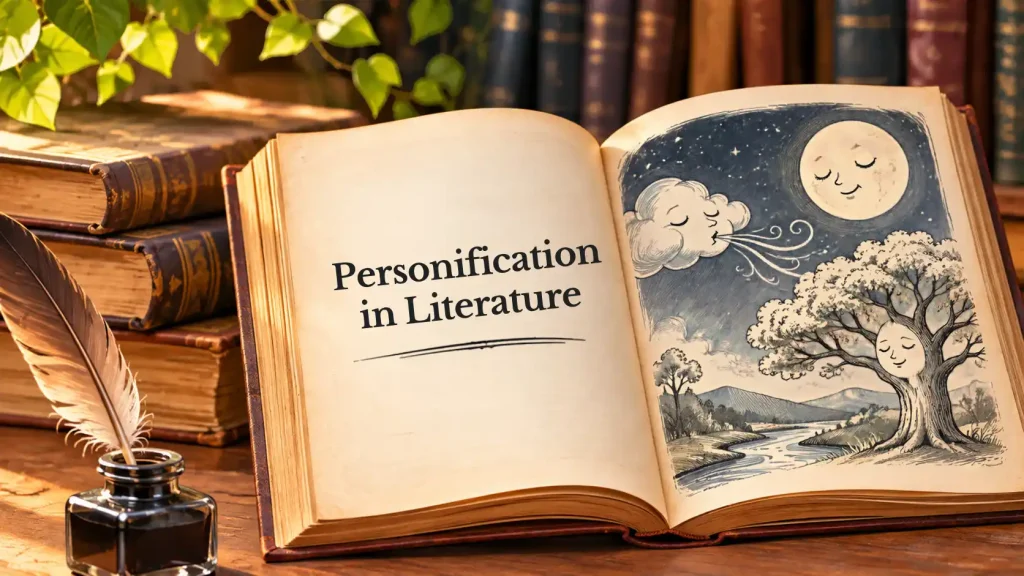
Personification is a kind of figurative language used when an author attributes human qualities to an object that is not a human.
To put it simply, it is the description of animals, objects, places, or ideas like humans.
For example:
“The flowers danced in the morning breeze.”
Flowers cannot dance like people. However, this sentence makes us imagine flowers moving gently in the wind, almost as if they were dancing.
Here is another example:
“The angry storm knocked on our windows.”
The storm can neither become angry nor knock on the window. These are activities and emotions experienced by humans only. They help the storm appear stronger in the sentence.
Personification does not indicate that an object is made into a human being. It is just an imaginative description.
You may also like – Top 10 Public Libraries in Noida & Study Spaces
You may also like – 15 Best Historical Fiction Books of All Time to Read
Personification Meaning and Definition
The word personification comes from the idea of making something appear like a person.
In literature, it means giving human features to something that is not human. These features may include:
- Human actions: Dancing, laughing, crying, speaking, or walking.
- Human feelings: Happiness, sadness, anger, fear, or love.
- Human thoughts: Thinking, remembering, hoping, or dreaming.
- Human behaviour: Welcoming, refusing, helping, or arguing.
For example, consider this sentence:
“The old house stood silently and watched the village.”
A house can not watch anything. Watching is something that humans do. By attributing this human characteristic to the house, the author paints a picture of an old house that has been brought to life.
You may also like – 15 Best Funny Books of All Time That Will Make You Laugh
You may also like – Best Literary Magazines for Writers and Readers
20 Easy Examples of Personification
The easiest way to understand personification is through examples. Below are 20 simple sentences that show how it works.
| No. | Personification example | Human quality |
|---|---|---|
| 1 | The sun smiled at the children. | Smiling |
| 2 | The wind whispered through the trees. | Whispering |
| 3 | The flowers danced in the breeze. | Dancing |
| 4 | The stars winked at us. | Winking |
| 5 | The alarm clock shouted at me. | Shouting |
| 6 | The leaves waved goodbye. | Waving |
| 7 | The angry clouds covered the sky. | Anger |
| 8 | The moon followed me home. | Following |
| 9 | The old door groaned when I opened it. | Groaning |
| 10 | The river sang a beautiful song. | Singing |
| 11 | The fire swallowed the dry wood. | Swallowing |
| 12 | The rain tapped on my window. | Tapping |
| 13 | My phone refused to work. | Refusing |
| 14 | The road welcomed us to the village. | Welcoming |
| 15 | Time ran away from me. | Running |
| 16 | The mountain stood proudly. | Showing pride |
| 17 | The trees stretched their arms towards the sky. | Stretching |
| 18 | The cold wind slapped my face. | Slapping |
| 19 | The camera loved the bright sunlight. | Loving |
| 20 | The little candle fought against the darkness. | Fighting |
These are original, simple examples created to explain the device. They show how ordinary things can seem more alive through human actions and feelings.
5 Examples of Personification Explained
Let’s look at five examples more closely.
1. The sun smiled at the children.
The sun is unable to grin. But the sunshine feels cozy, cheerful, and inviting because of this line.
2. The wind whispered through the trees.
One thing that people do is whisper. This statement makes it easier for readers to picture the gentle sound of the wind blowing through the foliage.
3. The stars winked at us.
There is no way that stars have eyes. The term “winked” gives a playful feeling to their tiny movements.
4. The alarm clock shouted at me.
The alarm clock cannot shout. However, its loud sound is similar to shouting, particularly if it goes off very early in the morning.
5. The little candle fought against the darkness.
A candle cannot fight. This sentence illustrates how its feeble light is resisting the darkness surrounding it.
You may also like – Shadow Archetype: Meaning, Examples & Carl Jung’s Theory
Uses of Personification in Literature

Personification is a significant literary device. It is used by writers to make the description more vivid and enable the reader to relate to it.
Here are some common uses.
1. To Make Writing More Interesting
Simple descriptions might sometimes be boring. Personification makes them lively and dynamic.
For example:
- Simple: The wind was strong.
- With personification: The wind pushed against the trees.
The second sentence provides a better description of the strength of the wind.
2. To Create Clear Pictures in the Reader’s Mind
Authors expect readers to visualize the settings and occurrences in their stories.
For instance, the statement “The moon smiled over the serene village” paints a peaceful image. The night appears to be friendly and peaceful.
3. To Show Feelings and Emotions
Personification allows a writer to express emotions without explaining them.
For example:
“The dark clouds cried over the empty field.”
This sentence uses crying to set the mood for sadness. It could help readers realize that something unhappy took place.
4. To Give Nature a Human Touch
One of the most typical subjects of personification is nature.
Poets portray the sun as smiling, the river as singing, and the tree as dancing. This makes the subject more relatable to the human world.
5. To Make Abstract Ideas Easier to Understand
It may be hard to define concepts like time, death, love, and freedom.
With personification, concepts like these are endowed with human characteristics. This makes it easier for people to visualize them.
You may also like – Best Leadership Books: 10 That Can Change Your Life
You may also like – 10 Best Nonfiction Audiobooks to Listen
You may also like – 10 Best Horror Graphic Novels That Will Give You Chills
Personification vs Anthropomorphism
Personification and anthropomorphism are very similar literary devices, but they are not synonymous with each other.
Anthropomorphism is when a non-human character acts human-like in a more full-fledged manner.
Consider these examples:
| Personification | Anthropomorphism |
|---|---|
| The wind whispered through the trees. | A talking wind character tells a story. |
| The flowers danced in the garden. | Flowers wear clothes and talk to each other. |
| The moon smiled at the children. | The moon becomes a character who speaks and makes decisions. |
The main difference is how the human qualities are used.
The wind doesn’t actually talk; rather, the sentence depicts the wind in human terms.
The animal may actually speak, think and act like a human being in anthropomorphism.
A good example is that of animals that speak and wear clothing in children’s stories.
Personification vs Metaphor and Simile

| Literary device | Meaning | Example |
|---|---|---|
| Personification | Gives human qualities to non-human things. | The sun smiled at us. |
| Metaphor | Describes one thing as another to show a connection. | Time is a thief. |
| Simile | Compares two things using “like” or “as.” | The clouds were like cotton. |
Personification vs Metaphor
Human actions or feelings to non-human objects.
Example: “The trees danced in the wind.”
Metaphor compares or equates two dissimilar objects.
Example: “The classroom was a zoo.”
In the first sentence, an action of dancing ascribed to trees, whereas in the second, classroom is equated with a zoo.
Personification vs Simile
Simile is the comparison of two unlike objects using words like “like” and “as.”
Example: “The moon was like a silver ball.”
Personification is giving a human attribute to an object.
Example: “The moon kept watch over the sleeping village.”
Similes make writing more engaging, but each produces its own unique effect.
How to Use Personification in Your Writing

Personification is helpful for poets, writers, students, and everyone who loves to write. It doesn’t require any fancy words to use effectively.

Follow these simple steps.
Step 1: Choose a Non-Human Thing
Start with an object, animal, place, or idea.
For example:
- The sun
- The wind
- A tree
- A river
- Time
- Fear
Step 2: Give It a Human Action or Feeling
Think about what a person might do or feel.
For example:
- Smile
- Cry
- Dance
- Whisper
- Laugh
- Feel lonely
Step 3: Make a Simple Sentence
Now combine the non-human subject with the human action.
Examples:
- The sun smiled at the village.
- The river sang through the valley.
- Fear knocked on his door.
- The old tree welcomed the birds.
Step 4: Check Whether It Makes Sense
Read your sentence again.
Ask yourself:
- Does it give a human quality to something non-human?
- Does it help readers imagine the scene?
- Does it match the mood of my writing?
- Is it easy to understand?
If the sentence feels natural and supports your message, it may be a good use.
Step 5: Do Not Use It Too Often
However, using it in every sentence can make your writing confusing.
Use it when it adds meaning, emotion, or a clear picture. Keep other sentences simple so the important descriptions stand out.
Common Mistakes to Avoid When Using Personification
Although personification is very simple to comprehend, there are times when it is used incorrectly.
Here are some errors that should be avoided.
1. Confusing personification with metaphor
A sentence must give a human quality or action to something non-human to count as personification.
2. Confusing personification with anthropomorphism
A talking animal in a story is usually an example of anthropomorphism. A sentence such as “The forest whispered” is personification.
3. Using too many examples in one paragraph
Too many imaginative descriptions can make a paragraph difficult to follow. Choose only the examples that help your message.
4. Using unclear descriptions
A sentence should help readers imagine something. If the human action does not fit the subject or the scene, it may confuse them.
5. Forgetting the purpose
Do not use personification in an attempt to make the sentence sound more imaginative. Use it to convey emotion, create a mood, or clarify a description.
Why Is Personification Important in Poetry and Stories?
Personification is important since it helps writers associate what surrounds us with the feelings and experiences of people.
In poetry, it will be possible to portray nature in a very vivid way. For instance, a poet can use a poem to tell how the river sings and flowers dance.
In literature, personification will be used to give settings a life of its own. An example of this would be when the dark forest appears to be watching the characters.
Writers can use it to give an easy-to-understand image for abstract ideas. For example, saying “hope opened a door” is much easier to understand than saying that hope offered a fresh start.
Conclusion
Personification is a technique that is easy to use yet makes the text very engaging. It endows animals, objects, places, and ideas with human characteristics.
From the smiling sun to the dancing flowers, these descriptions help the reader create images and relate to the story. Some of the great poets like Emily Dickinson, John Donne, and William Wordsworth have made use of personification in their work.
Frequently Asked Questions
1. What is personification in simple words?
Personification is a figure of speech that gives human qualities, actions, or feelings to non-human things. For example, “The sun smiled at me” is personification.
2. What are 5 examples of personification?
Here are five simple examples:
- The wind whispered through the trees.
- The flowers danced in the garden.
- The stars winked at us.
- The alarm clock shouted at me.
- The river sang a beautiful song.
3. Is personification a figure of speech?
Yes. Personification is a figure of speech and a literary device. It gives human qualities to animals, objects, places, or abstract ideas.
4. What is personification in literature?
Personification in literature is a writing technique in which authors give human actions, feelings, or qualities to non-human things. It helps create strong images and emotions in poems, novels, and stories.
5. What is the difference between personification and anthropomorphism?
Personification uses human qualities in a figurative way. Anthropomorphism shows non-human characters behaving like humans, often by speaking, thinking, and acting like people.