

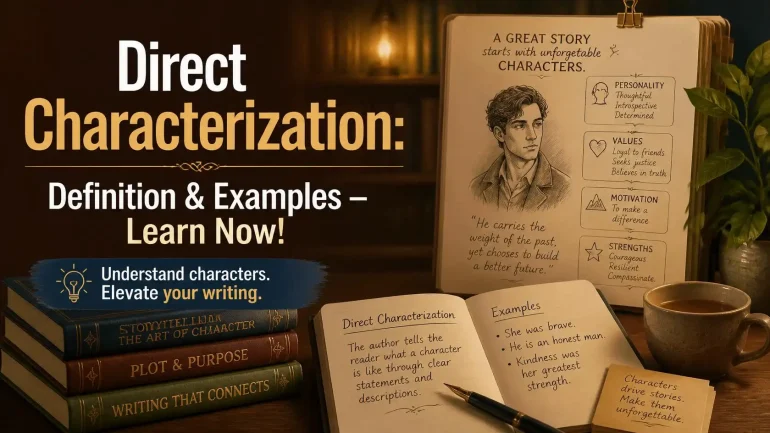
Have you ever opened a novel and instantly felt like you knew the main character inside and out within just two sentences? That isn’t magic it’s direct characterization.
When an author steps forward to tell you exactly what a character is like, they are using a precise storytelling tool. As a writer, poet, or avid reader, understanding how explicit descriptions work gives you total control over story pacing, character depth, and narrative voice.
While creative writing teachers often chant the famous rule “Show, Don’t Tell,” the truth is far more nuanced. Direct characterization is the key to telling efficiently so that your showing hits harder.
In this guide, we’ll break down the definition, explore famous direct characterization examples, compare direct and indirect characterization, and uncover how to master both techniques in your own creative work.
What is Direct Characterization?
Direct characterization (also known as explicit characterization) occurs when the author, narrator, or another character directly describes a character’s traits, appearance, personality, or background in plain language.
Instead of forcing the reader to deduce who a person is through subtle clues, the narrator hands the facts straight over.
Key Characteristics:
- Explicit Statements: Traits are named directly (e.g., “She was stubborn,” “He was remarkably tall”).
- Immediate Clarity: Leaves no room for reader misinterpretation regarding core facts.
- Efficient Pacing: Delivers background details or visual traits without slowing down narrative momentum.
Literary Takeaway: Think of direct characterization as a narrator handing you a character’s profile card. It sets clear expectations immediately.
You may also read: Famous Writers in UK: 25 Legendary Authors – Explore Now!
You may also like: Writing Elements: 10 Essential Basics You Must Know Today!
Direct vs. Indirect Characterization: The Core Difference
To master character construction, you need to understand the relationship between direct and indirect characterization.
While direct characterization tells the reader what a character is like, indirect characterization shows their personality through five key avenues:
- Speech (What they say and how they say it)
- Thoughts (Internal monologue)
- Effect on others (How surrounding characters react to them)
- Actions (What they physically do)
- Looks (Visual cues that imply personality traits)
This is commonly known in literary analysis as the STEAL method.
| Feature | Direct Characterization | Indirect Characterization |
| Primary Method | Telling (Explicit statement) | Showing (Implicit clues/STEAL) |
| Reader Effort | Low (Facts provided directly) | High (Reader infers meaning) |
| Pacing Impact | Fast & efficient | Gradual & immersive |
| Best Used For | First introductions, physical traits, establishing quick context | Emotional depth, complex relationships, subtext |
Both techniques are essential. Relying entirely on indirect cues can make your narrative vague, while using only explicit statements makes a story feel like a dry police report. The magic happens in the balance.
You may also check: Round Character: Meaning, Examples & Guide – Learn Now!
You may also like: Ali Hazelwood Books in Order: Read Them All Now!
Classic Direct Characterization Examples from Literature
Let’s look at how famous authors use direct and indirect characterization examples in masterworks to build unforgettable figures.
1. The Great Gatsby by F. Scott Fitzgerald
“He was a blonde, spiritless man, anaemic, and faintly handsome.”
Fitzgerald uses blunt, explicit language to describe George Wilson. Before Wilson ever speaks or acts, we know his physical state and passive temperament.
In The Great Gatsby, Direct Characterization appears when the narrator, Nick Carraway, explicitly describes characters such as Jay Gatsby, Daisy Buchanan, and Tom Buchanan. These clear descriptions reveal their personalities, appearances, and social status without requiring readers to infer every detail. By combining direct observations with later actions, Fitzgerald creates memorable, layered characters that drive the novel’s enduring appeal.
2. Pride and Prejudice by Jane Austen
“Mr. Bennet was so odd a mixture of quick parts, sarcastic humour, reserve, and caprice, that the experience of three and twenty years had not been sufficient to make his wife understand his character.”
Austen outlines Mr. Bennet’s primary personality traits directly in the opening chapter. This explicit breakdown establishes his dynamic with Mrs. Bennet immediately.
In Pride and Prejudice, Jane Austen frequently uses Direct Characterization to introduce key traits of characters like Elizabeth Bennet and Mr. Darcy. The narrator openly describes their personalities, manners, and social standing, giving readers a clear first impression. These direct descriptions establish expectations while allowing the characters to develop through their actions and relationships as the story unfolds.
3. A Christmas Carol by Charles Dickens
“Oh! But he was a tight-fisted hand at the grindstone, Scrooge! a squeezing, wrenching, grasping, scraping, clutching, covetous, old sinner!”
Dickens doesn’t beat around the bush. He piles on explicit adjectives to ensure the reader understands Ebenezer Scrooge’s miserly nature right from the start.
In A Christmas Carol, Charles Dickens uses Direct Characterization from the opening pages by describing Ebenezer Scrooge as cold-hearted, miserly, and unfriendly. These explicit descriptions immediately establish his personality and set the stage for his transformation. As the story progresses, readers can clearly see how his actions evolve, making his character development even more powerful and meaningful.
You may also check: Narrative Writing: Tips, Examples & Guide – Start Today!

You may also like: Best Poetry: Timeless Poems You Must Read Today!
4 Types of Direct Characterization Writers Should Master
Direct characterization isn’t just saying “She was nice.” You can deliver direct character details in four distinct ways:
1. Narrator Description
Narrator Description is one of the most common types of Direct Characterization, where the narrator explicitly tells readers about a character’s appearance, personality, emotions, or values. Rather than encouraging readers to infer traits through actions, the author presents them directly. This approach quickly establishes a clear understanding of the character and helps readers connect with their role in the story from the beginning.
- Example: “Julian was fiercely loyal, almost to a fault.”
2. Dialogue from Other Characters
Dialogue from Other Characters is a powerful type of Direct Characterization where one character explicitly describes another through spoken words.Instead of leaving readers to assume personality traits, the dialogue explicitly shows virtues like kindness, bravery, brilliance, and weaknesses. When employed correctly, this strategy develops character interactions, builds credibility, and helps readers grasp a character’s role in the plot.
- Example: “Don’t bother arguing with Sarah,” Tom warned. “She’s the most stubborn attorney in the state.”
3. Self-Assessment
Self-Assessment is a type of Direct Characterization in which a character openly describes their own personality, emotions, strengths, or weaknesses. Since the information comes directly from the character, readers gain immediate insight into their thoughts and self-image. This technique creates a stronger emotional connection while revealing how the character perceives themselves, whether accurately or with personal bias.
- Example: “I’m not a brave person. In fact, I panic at the slightest noise in the dark.”
4. Visual & Physical Declarations
Visual & Physical Declarations are a type of Direct Characterization in which the author clearly describes a character’s physical appearance, clothing, facial expressions, or distinctive features. Instead of leaving readers to imagine these traits from context, the narrator states them outright. This technique creates a vivid first impression, helps readers visualize the character, and reinforces important aspects of their identity.
- Example: “He wore a faded military jacket from the 1990s and carried the tired stance of a retired drill sergeant.”
You may also read: Creative Writing Tips: 25 Expert Hacks to Write Better Today!
You may also check: Rachel Gillig Books: Best Novels Ranked – Read Now!
When to Use Direct Characterization in Your Writing
Knowing when to use explicit descriptions separates amateur writers from pros. Here are the four ideal moments for direct characterization:
- Introducing Minor Characters: Background figures don’t always need complex, multi-chapter reveals. State who they are so the focus stays on your lead characters.
- Establishing Baseline Traits Quickly: Use explicit detail early on so readers have a solid visual anchor before action begins.
- Contradicting Actions (Creating Irony): State a trait directly, then have the character act in the opposite way to create subtext and irony.
- Controlling Narrative Pace: During fast-paced action sequences, explicit descriptions prevent the momentum from stalling.
For deeper insights into story structure and narrative flow, explore research resources like the Purdue Online Writing Lab (OWL) or literary guides on The British Library Literature Engine.
Conclusion
In conclusion, Direct Characterization is an essential storytelling technique that helps readers quickly understand a character’s personality, appearance, emotions, and motivations through explicit descriptions. By mastering Direct Characterization, writers can establish memorable characters, create stronger emotional connections, and build engaging narratives from the very beginning.
While combining direct and indirect characterization often produces the richest character development, knowing when to use Direct Characterization can make your writing clearer and more impactful.
Whether you’re analyzing literature or crafting your own stories, practicing Direct Characterization will enhance your storytelling skills and help you create characters that readers remember long after they finish the final page.
